
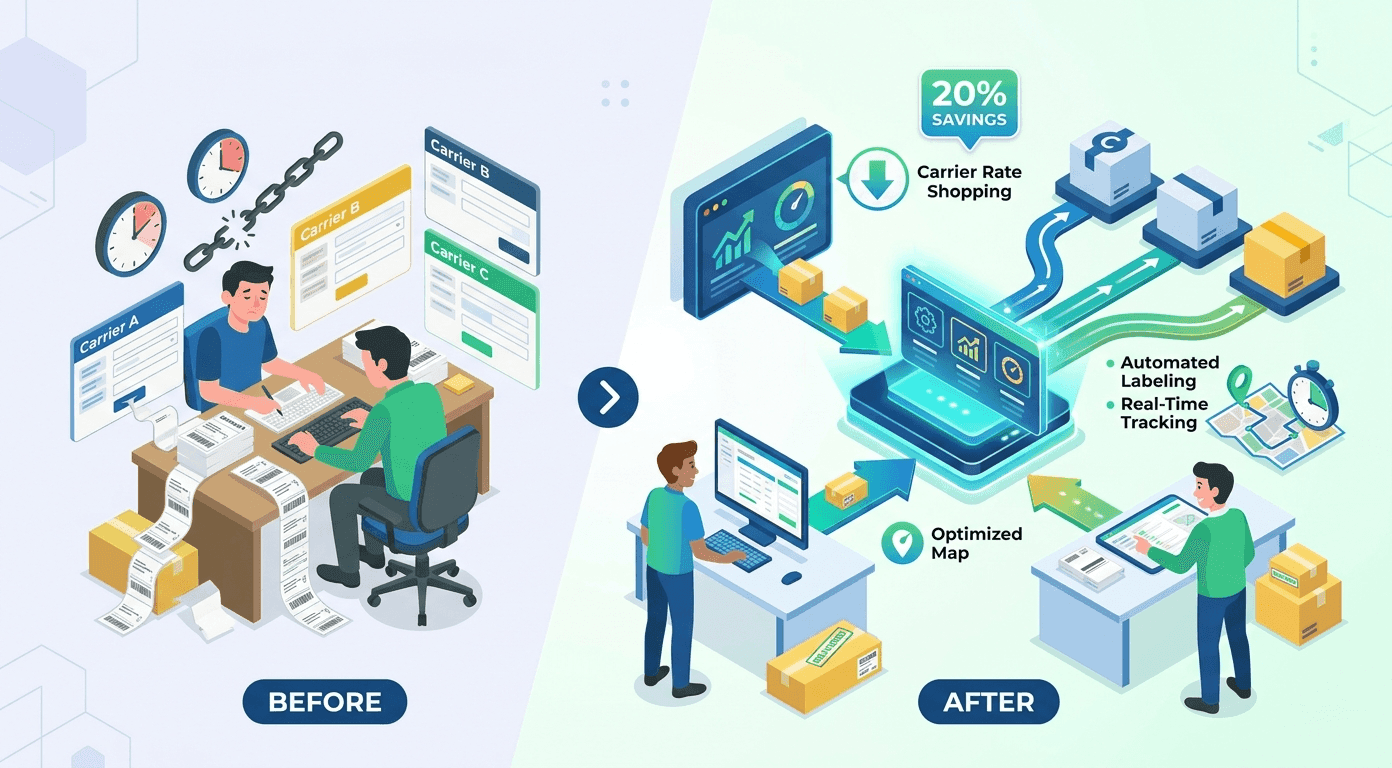
How Integrated Shipping Gateways Save E-commerce Brands 20% on Logistics
In 2026, e-commerce success is won or lost in the "last mile." While most brands focus on marketing and site design, the most successful million-dollar brands are quietly optimizing the one area that usually eats 30% of their revenue: Logistics.
If your team is still manually copying addresses into carrier portals or guessing which box size is cheapest, you aren't just losing time—you’re losing an average of 20% in potential profit. Here is how integrated shipping gateways are transforming logistics from a cost center into a competitive advantage.
The High Cost of Manual Logistics
When your shipping isn't integrated, every order creates a chain of manual tasks.
The Human Error "Tax": A single typo in a zip code can lead to a "Return to Sender" fee, a lost customer, and a second shipping charge.
Label Lag: Manually generating labels for 50 orders can take hours. In an integrated system, it takes seconds.
How Integration Slashes 20% Off the Bottom Line
1. Real-Time Rate Shopping
An integrated gateway acts like an "Expedia" for your parcels. The moment an order is placed, the system pings multiple carriers (FedEx, UPS, DHL, and regional couriers) to find the absolute lowest rate for that specific weight and destination. Brands using multi-carrier integration often find that "Carrier A" is cheaper for 5lb boxes, while "Carrier B" wins on overnight envelopes.
2. Automated Label & Manifest Creation
With [suspicious link removed], your shipping gateway is part of the build. Labels are generated automatically the moment the order is marked "Ready." This eliminates the need for a dedicated "Data Entry" person in the warehouse, instantly reducing labor costs.
3. Dynamic Zone Optimization
Integrated systems use "Zone Skipping" logic. By analyzing where your customers live, the system can suggest which fulfillment center to ship from, potentially turning a "Zone 8" (expensive) shipment into a "Zone 2" (cheap) shipment.
Beyond the Dollar: The Customer Experience
Savings aren't just about the label price. Integrated tracking reduces "Where is my order?" (WISMO) tickets by up to 40%. Instead of sending customers to a generic carrier site, an integrated gateway allows you to provide a [suspicious link removed] that keeps the customer inside your ecosystem.
For global brands, these gateways provide Landed Cost Transparency. By calculating duties and taxes (DDP) at checkout, you eliminate the "surprises" at the border that lead to refused packages and high return costs.
Build E-commerce: We Handle the Integration, You Handle the Growth
The biggest barrier to integrated shipping is the technical setup. Connecting multiple carrier APIs to your checkout logic is complex and expensive for a traditional agency.
At [suspicious link removed], we include these integrations as a standard part of our service. Our professional developers build the "bridge" between your store and your carriers, ensuring that from Day 1, your logistics are as optimized as your marketing.
Conclusion: Making Shipping a Profit Center
In 2026, you cannot afford to have a "leaky" supply chain. Integrated shipping gateways provide the automation needed to scale without adding headcount.
Ready to stop overpaying for every parcel? Join Build E-commerce today and let us build a store that ships smarter.