
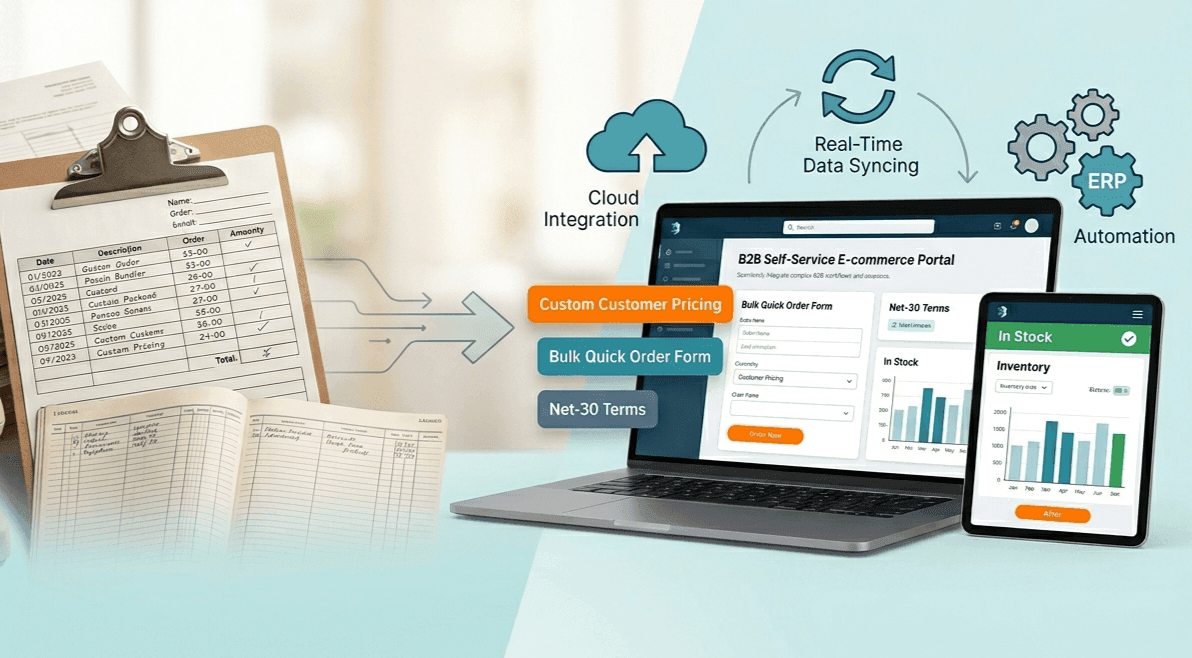
Wholesale Digital Transformation: Moving Your B2B Store Online Without Disrupting Operations
For many wholesale businesses in 2026, "Digital Transformation" sounds like a threat rather than an opportunity. The fear is always the same: “We have complex pricing, legacy systems, and 20-year relationships. If we move online, will we break the very thing that makes us successful?”
The truth is that B2B e-commerce digital transformation isn't about replacing your sales team or your existing processes; it’s about digitizing them. Successful transformation doesn't force your business to fit into a rigid "online store" box. Instead, the technology must be customized to fit your business requirements.
The Core Challenge: Why Standard E-commerce Fails Wholesalers
Most "off-the-shelf" e-commerce platforms were built for retail (B2C). They struggle with the heavy lifting required for wholesale:
Negotiated Pricing: Unlike retail, B2B pricing is rarely one-size-fits-all. Every client might have a different contract rate.
Bulk Ordering Logic: Wholesalers need tools for "Quick Order" forms, bulk CSV uploads, and strict MOQs (Minimum Order Quantities).
Payment Terms: In B2B, "Add to Cart and Pay" is often replaced by "Purchase Orders" and "Net-30" credit terms.
3 Steps to a Disruption-Free Migration
To move online without stopping your warehouse from shipping, you need a strategic approach:
1. Audit Your Existing Offline "Rules"
Before writing code, document every "special case." Do you give free shipping to clients over $5,000? Do specific regions have different tax rules? Your digital store must mirror these rules from day one.
2. Prioritize Customer Self-Service
Digital transformation should make your customers' lives easier. Give them a portal where they can view their order history, download invoices, and re-order their "usual" with one click. This reduces your team's manual data entry by 40-60%.
3. Ensure Real-Time Sync
Disruption happens when your online store says you have stock that your warehouse already sold via a phone order. Your digital platform must integrate seamlessly with your existing inventory management to provide a "single source of truth."
Customization: The Heart of B2B Success
No two wholesale businesses operate exactly the same way. This is why "No-Code" builders often fail at the enterprise level. B2B requires specialized customization—whether it’s a [suspicious link removed] or a [suspicious link removed].
How Build E-commerce Protects Your Operational Integrity
At [suspicious link removed], we don't give you a template and wish you luck. We act as your outsourced development and operations team.
We Build Around Your Requirements: We don't ask you to change your pricing or shipping rules. Our developers build the logic into your store so it works exactly like your offline business.
Zero-Cost Infrastructure: We provide the enterprise-grade servers needed to handle large-scale B2B catalogs (10,000+ SKUs) without additional hosting fees.
24/7 Support: If an integration hits a snag or a buyer has trouble with a custom portal, our team is there to fix it instantly, ensuring your operations never stop moving.
Conclusion: Scaling Without the Growing Pains
Moving your wholesale business online doesn't have to be a "rip and replace" operation. By focusing on customization and operational continuity, you can move from manual spreadsheets to a scalable digital engine.
Ready to modernize your wholesale operations? Join Build E-commerce today and let us build a B2B store that works as hard as you do.